
Pharmacy closures are accelerating in rural communities, driven by financial pressures, workforce challenges, and shifting care models. Policymakers and boards of pharmacy are exploring strategies to preserve access and support sustainable practice.
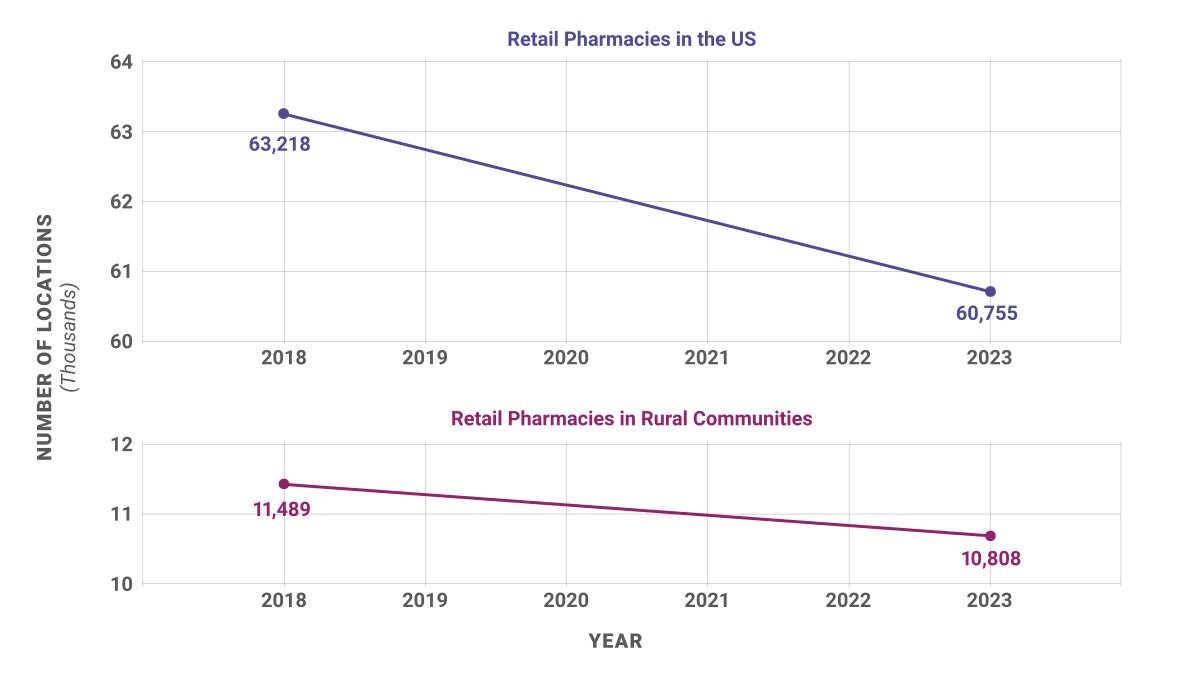
Community pharmacies play a critical role in rural health care, providing access to prescriptions, clinical expertise, and essential services even in the most remote locations. Yet, rural communities continue to be disproportionately affected by pharmacy closures nationwide. A 2024 report from the Rural Policy Research Institute (RUPRI) Center for Rural Health Policy Analysis found that retail pharmacies in the US declined by 3.9% overall from 2018-2023, with a higher decline of 5.9% in rural communities.
Accelerating Declines in Rural Pharmacies
These findings are consistent with a 2022 RUPRI policy brief on rural pharmacy closures. Between 2003 and 2021, the total number of independently owned, chain, and franchise pharmacies declined by 9.8% in rural, “noncore” communities (fewer than 10,000 people) and 4.4% in rural micropolitan communities (10,000-49,999 people).
Nearly half of rural pharmacies are sole, independently owned retail stores, which have experienced higher closure rates than those in metropolitan areas. Between 2003 and 2021, the number of independent pharmacies declined by 16.1% in noncore areas and 9.1% in micropolitan areas.
RUPRI reports also found:
- Between 2018 and 2023, 184 rural communities lost all local retail pharmacy services, but 195 other rural communities also gained retail pharmacy services.
- During that same 5-year period, more than two-thirds of the rural communities gaining a retail pharmacy (69.5%) or losing a retail pharmacy (63.5%) were located in the smallest rural communities.
- In 2020 and 2021, new independent pharmacies opened in some of the most rural communities to fill voids where large pharmacy chains had closed their stores – changes in pharmacy distribution perhaps spurred by the COVID-19 pandemic.
Multiple Pressures Contribute to Rural Pharmacy Closures
Rural independent pharmacy owners participating in the 2022 RUPRI study reported low reimbursement rates and delays in payments as the most significant challenges to remaining open. Other challenges facing rural community pharmacies can be workforce related. Rural towns often have only one pharmacy serving the community, with a single pharmacist-owner to run the business. When such rural pharmacies close due to financial hardships, it can be difficult to replace them and recruit new pharmacists due to ongoing shortages of qualified pharmacists and competition from higher-paying jobs in metropolitan regions.
In response, rural communities are increasingly relying on mail-order pharmacy and telepharmacy models, in which a technician is based in a rural location and remotely supervised by a pharmacist.
However, because telepharmacy is regulated on a state-by-state basis, it is not yet viable for all rural communities. As of 2025, 28 states permit some form of telepharmacy, while 22 restrict or prohibit it, which creates significant compliance, licensing, and operational challenges.

Rural Pharmacy in a Snapshot
- 46.1 million Americans live in rural areas.
- 5.9% of rural retail pharmacies were lost between 2018 and 2023.
- 184 rural communities have lost all pharmacy access.
- 80% of rural America is medically underserved.
Research from S&S Insider Pvt, Ltd
NABP and Board of Pharmacy Initiatives Address Rural Pharmacy Closures
By allowing additional practice opportunities for pharmacists, states can help ensure patient access to pharmacy services. For example, Alaska, Idaho, Iowa, and Montana allow pharmacists to independently perform functions for which they are trained and qualified, and those boards of pharmacy regulate those functions based on a standard of care model.
Boards of pharmacy can also promote accessibility by considering approval for new technologies, such as those rural and other pharmacies may use to support patient access. Telepharmacy platforms, artificial intelligence tools, automation solutions, augmented reality and virtual reality software, and innovative medical devices promoting patient self-care are just a few examples.
NABP recently established its Research and Innovation Institute to provide resources for boards of pharmacy and other pharmacy stakeholders while navigating emerging technologies. When evaluating the need for new or updated technology, NABP encourages boards of pharmacy to identify and address any regulatory burdens that reduce a pharmacy’s ability to operate as efficiently as possible.
NABP also partnered with boards of pharmacy to convene a Task Force on Shared Pharmacy Services, Automated Pharmacy Systems, Remote Dispensing Sites, and Telepharmacy. In 2024, this task force reported on the trends putting pressure on the practice of pharmacy to “do more with less,” noting that such trends may require community pharmacies to change their practice models to ensure their viability in the years to come. The task force also recognized the duty of boards of pharmacy to ensure that pharmacies have the latitude to implement necessary changes.
Ultimately, boards of pharmacy may consider additional approaches to support rural pharmacies and improve patient care in those communities. The Arkansas State Board of Pharmacy provides one useful model with its Student Scholarship/Loan Program, which gives university students pursuing pharmacy careers within rural areas of the state the opportunity to receive a tuition loan that does not require repayment if they meet certain criteria.
Investments like these can help attract pharmacists to rural communities, strengthening the workforce and improving patient access to care.
This blog was adapted from an article that originally appeared in the July/August 2026 issue of Innovations.