Keeping the prescription drug supply chain secure is essential for ensuring patient safety. However, the immense scale and complexity of the global supply chain have made it a persistent target for criminal organizations. The fight against falsified medications demands constant innovation and adaptation. As counterfeit methods evolve, so must the strategies used to detect and prevent them, requiring increasing collaboration across the supply chain to protect patients.
Why Drug Supply Chain Security Matters
Even in the US, a market which experts consider among the safest in the world, the prescription drug supply chain has been compromised by several high-profile schemes related to brand medications in recent years. One case uncovered in 2021 and 2022 involved selling counterfeit HIV medications to pharmacies, which in turn dispensed falsified medication bottles to patients. Investigators discovered that accused distributors of fraudulent products disguised the medications as legitimate Biktarvy® and Descovy®, ultimately trafficking over $250 million in fake drugs, disseminated to hundreds of independent pharmacies across 36 states.
These incidents are not isolated; falsified and diverted products have surfaced across multiple drug classes. From oncology therapies and cosmetic injectables to high-demand chronic care medications, these incidents reveal the breadth of vulnerabilities within the supply chain.
Today, the nature of the threat is shifting. High-demand, high-value products such as the popular glucagon-like peptide drugs (GLP-1s) used for weight loss and diabetes management (notably, Ozempic® and Wegovy®) have been met with a surge of falsified and substandard versions being offered both to pharmacies and consumers at discounted prices.
The ensuing harm to patients and the erosion of trust underscored the urgent need for stronger safeguards and a more transparent system.
Strengthening the Supply Chain Through DSCSA
The primary legislative framework governing the security of the US drug supply chain is the Drug Supply Chain Security Act (DSCSA). The legislation was intended to create a single, unified, and interoperable system for tracing chain-of-ownership prescription medications from the point of manufacture to the point of dispensing.
Over the past decade, stakeholders across the supply chain have worked to meet DSCSA requirements, including the serialization of saleable units and homogenous case packaging, enabling product verification to allow real-time comparison of packaging serialization with manufacturing records, and enhanced data exchange of serialization data with these products. The final phase of implementation mandated several core requirements, including the following:
- Manufacturers must affix product identifiers (including the Global Trade Item Number (GTIN), a unique serial number, lot number, and expiration date) onto all prescription drug packages using a 2D Data Matrix barcode.
- Trading partners must send and receive data electronically.
- Trading partners must provide transaction information, and a transaction statement with each product transfer.
- Product tracing must be conducted to allow authorized agents to gather transaction information in order to create a clear transaction history of ownership.
While DSCSA has succeeded in enhancing serialization and creating a foundation for full electronic tracing, it has been constructed on a decentralized data storage model. In this model, every trading partner, including manufacturers, distributors, repackagers, and dispensers, is responsible for storing their own complete set of serialized transaction data. There is no single national database containing all serial numbers or transaction information.
This decentralized approach presents a significant challenge for the boards of pharmacy and other regulatory bodies. In the event of a drug diversion scheme or a suspected falsified batch, a state board of pharmacy or other regulator must individually query dozens, perhaps hundreds, of trading partners to fully track a suspicious lot or product. This manual, time-consuming process may hinder the rapid, real-time investigations required to quickly remove dangerous products from circulation.
How Pulse Can Help Secure the Supply Chain
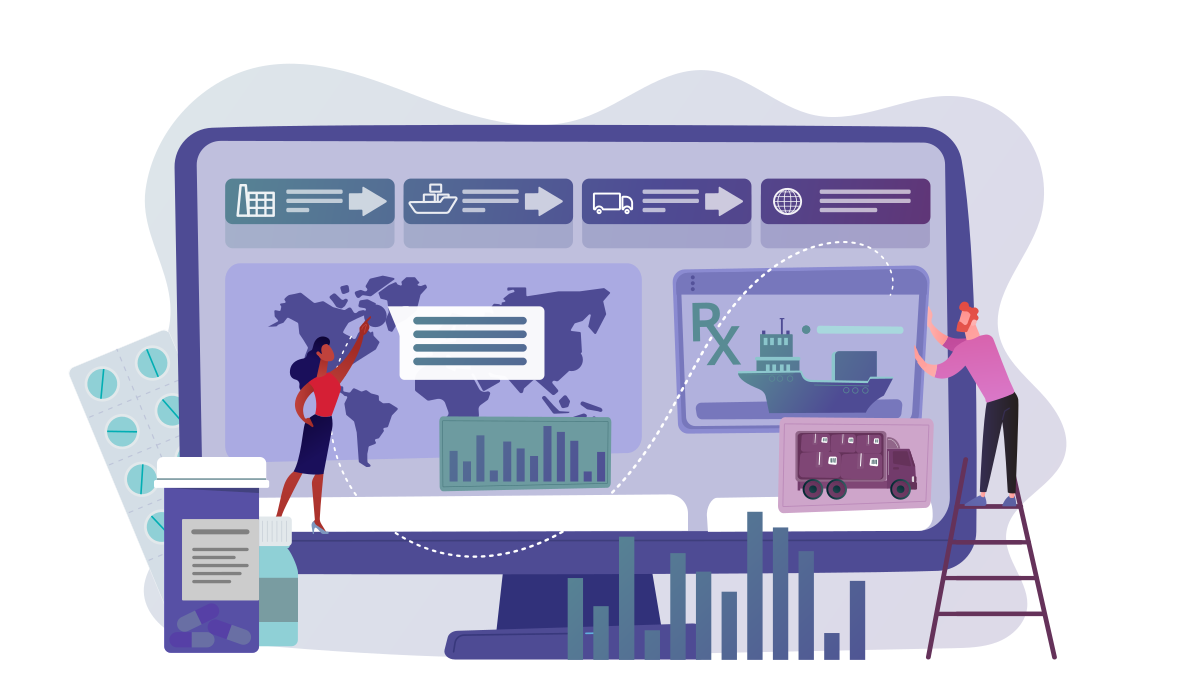
After working with federal and state regulators and other stakeholders to assist with DSCSA implementation, NABP saw that there was a critical need to improve access to verification data. Thus, Pulse by NABP was created to provide the necessary tools to help enable full interoperability between trading partners and regulators. A key component of the platform is the primary product verification service (PVS) for state and federal regulators and pharmacies. Pulse functions as a secure method for state regulators to enter the unique product identifiers from a suspect package and instantly query the relevant manufacturer’s data system. This swift, secure, and authenticated communication is essential for confirming the legitimacy of a suspect or illegitimate product. The platform has already demonstrated its vital potential for catching suspect products and protecting public health in Arkansas, Mississippi, and Ohio.
In January 2025, the Arkansas State Board of Pharmacy verified a suspect Ozempic product by using the Pulse(PVS). An inspector from the Arkansas Board used the Pulse tool on his mobile phone to confirm the illegitimacy of the suspect Ozempic product quarantined at an Arkansas pharmacy within seconds. Utilizing the response from the product verification as part of the submitted evidence, the Board launched an investigation of the seller, held an emergency hearing, and suspended the seller’s license, which was being used outside of its scope. This incident demonstrates how Pulse has rapidly become an essential tool for US regulators. With over 120 state regulators and Drug Enforcement Administration (DEA) now participating, the platform has already processed over 1,600 product verification requests.
State regulators have seen benefits in utilizing the Pulse PVS. In a recent blog post, Jenni Wai, MBA, RPh, chief pharmacist of the Ohio Board of Pharmacy, and John Kirtley, PharmD, Executive Director of the Arkansas State Board of Pharmacy explained how the technology has helped to protect patients in their jurisdictions.
Scaling Effective Models Beyond US Borders
The deployment of Pulse PVS marks a major milestone in securing the country’s domestic supply chain. However, pharmaceutical bad actors often work across national borders. A successful long-term strategy to combat counterfeit and substandard medications will require the seamless adoption of exacting standards and technological tools at a global level.
NABP is committed to leveraging the standards and technology developed for Pulse to fortify supply chains in other parts of the world. This commitment to global security is exemplified by Operation African Star 2, a Pharmaceutical Traceability Pilot Program conducted in East Africa. The initiative demonstrated how the Pulse platform, built to provide a solution for the domestic supply chain, can be equally effective as a complementary communications tool to help national health regulatory authorities secure supply chains and protect patients worldwide from falsified medications.
Through ongoing collaboration, NABP remains committed to fulfilling regulatory responsibilities, and to strengthening the integrity of the supply chain.
This blog was adapted from an article that originally appeared in the January/February 2025 issue of Innovations.