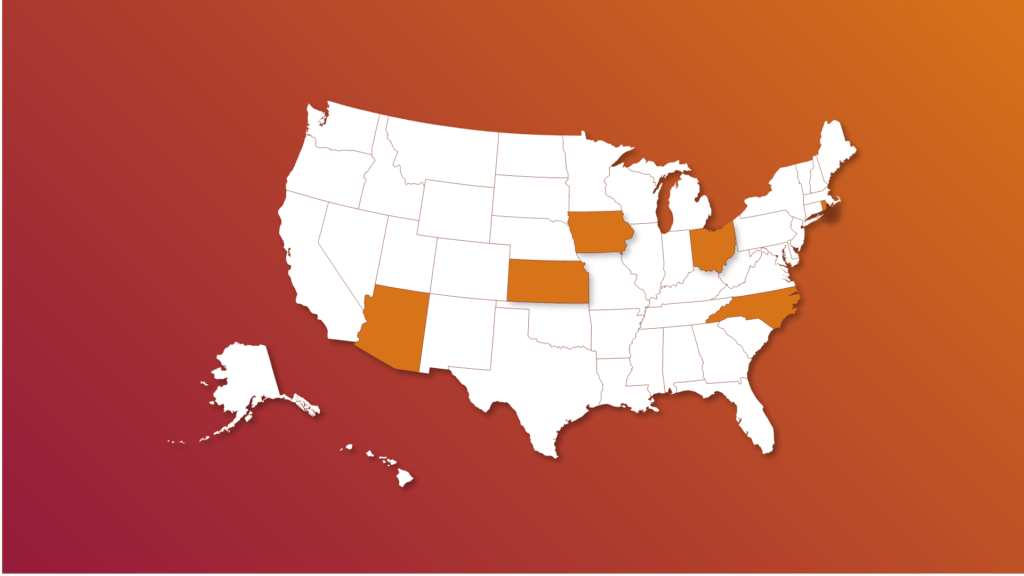
In the Uniform MPJE™ (UMPJE™) early adopter states – Arizona, Iowa, Kansas, North Carolina, Ohio, and Rhode Island – candidates have begun taking this new exam. With more pharmacists obtaining licensure in multiple states than ever before, the UMPJE was created to provide an additional pathway for pharmacist license portability across multiple states. This tool has the potential to more easily streamline license portability for those who utilize the score transfer and license transfer processes. Boards of pharmacy will have the option to use the new UMPJE, or they may continue to use the current state-specific version of the Multistate Pharmacy Jurisprudence Examination® (MPJE®).
The UMPJE offers flexibility in an increasingly complex regulatory environment. Candidates seeking licensure in multiple jurisdictions will only need to pass a single law exam, as long as those jurisdictions adopt the UMPJE. As a result, the overall cost and time required to obtain licensure across multiple jurisdictions are expected to decrease.
Registration opened for the early adopter states in March 2026, and the administration phase began on April 1, 2026. The general adoption period begins in May when registration opens for candidates in other participating states; exam administrations in those states will begin on June 1, 2026.
UMPJE Application and Exam Format
The exam application process is very similar to the current state-specific MPJE; however, there are two processes that mirror the North American Pharmacist Licensure Examination® (NAPLEX®). As with the NAPLEX, candidates will select their primary jurisdiction when applying for the exam. Also similar to the NAPLEX, the UMPJE score will be accepted by other participating jurisdictions, so candidates’ scores will be applied toward the licensure-by-examination requirements of the state where they transfer their scores.
The exam mirrors the current MPJE layout, with 120 questions and 180 minutes of seat time. One difference is that the UMPJE features single-answer, multiple-choice questions with 3 options, while the state-specific MPJE offers 4- or 5-option multiple-choice questions and multiple-response question formats.
Like all NABP exams, the UMPJE is held to high standards of integrity and will undergo continuous monitoring to ensure fairness, consistency, and validity across participating jurisdictions.
Tools to Prepare for the UMPJE
NABP offers 3 important UMPJE preparation materials:
1. Candidate Application Bulletin
Our Bulletin provides all exam candidates with guidance and requirements for every step of the examination process, from applying to getting their results. All exam candidates should read the Candidate Application Bulletin thoroughly.
This exam blueprint provides key details about the exam’s format, question style, and content areas and offers sample questions. The UMPJE Content Outline was developed by a diverse panel of practicing pharmacists who conducted a comprehensive analysis of entry-level pharmacy practice.
3. Pre-UMPJE™
The Pre-UMPJE is the official practice exam for the UMPJE. It features 40 questions that have been developed based on the UMPJE Content Outline to represent the types of questions on this high-stakes exam. The Pre-UMPJE helps candidates gain experience with the test format and time requirements to reduce test day anxiety. This practice test can be taken independently, allowing practice at any time, without a proctored format. Results are available instantly after finishing the practice exam, providing guidance on content areas to focus on when studying.
Sign up to receive our blog posts straight to your inbox and follow us on social media for more exam tips and preparation content.
The UMPJE Will Not Replace the MPJE
There is no intention of replacing the MPJE with the UMPJE. The current MPJE remains a valuable, state-specific jurisprudence exam. Boards of pharmacy will continue to have the option to use the state-specific version of the MPJE as a critical component of the licensure process. The UMPJE provides states with an alternative option to assess pharmacy law competence and to fit the needs of pharmacists in their jurisdictions, should they choose to adopt it. For states adopting the UMPJE, the implementation timeline and the decision on transitioning from the state-specific MPJE to the uniform version vary by state. Candidates are encouraged to frequently check the NABP website and their board’s website for the latest updates.
Candidates who pass the UMPJE will still be held responsible for adhering to state-specific laws, even if the details are not addressed on the exam. To assist licensure applicants in meeting these expectations, some jurisdictions may have supplementary education requirements that focus on knowledge of state-specific rules. Boards of pharmacy, of course, retain the authority to grant licensure and enact rules for compliance with their regulations. Check with your state’s board of pharmacy to find out what specific requirements they might require.
NABP has a long history of offering exams to assess a pharmacist’s competency to practice. Our staff will work closely with boards of pharmacy, as well as the colleges of pharmacy in jurisdictions that adopt the exam, to ensure that candidates have all the necessary information needed prior to taking the new exam. Stay up to date and learn more about the UMPJE on our website.