
On December 1, 2025, the SUPPORT for Patients and Communities Reauthorization Act was signed into law. This legislation creates a federal pathway for pharmacists to prescribe buprenorphine to treat opioid use disorder (OUD) directly to patients. This landmark legislation will help pharmacists combat the opioid crisis across the US.
History of Pharmacists as Prescribers
Pharmacists have fought to prescribe certain medications directly to their patients for years, including birth control, flu and COVID medications, asthma inhalers, and more.
| 2013 | Pharmacists were designated as health care providers (HCPs) in California, significantly broadening the services they could provide to patients. Today, about one-half of states have designated pharmacists as HCPs, though pharmacists are not recognized as HPCs federally. Also in 2013, New Mexico became the first state to grant pharmacists independent prescriptive authority of naloxone after completion of the Naloxone Pharmacist Prescriptive Authority Certification. |
| 2016 | Oregon was the first state to allow pharmacists to prescribe contraceptive medications, followed by California soon after. Today, more than half of all states allow pharmacists to prescribe hormonal birth control. |
| 2018 | Idaho became the first state to allow pharmacists to prescribe broadly, allowing pharmacists to prescribe over 20 categories of medications without provider oversight. These categories include inhalers to treat asthmatic symptoms, insulin pen needles to treat diabetes, medications to treat minor conditions like lice or urinary tract infections (UTIs), and more. |
| 2022 | US Food and Drug Administration (FDA) federally authorized pharmacists to prescribe and administer Paxlovid, a medication to treat COVID-19, significantly increasing access to the drug. By this year, 20 states had granted prescriptive authority to pharmacists to provide naloxone directly to patients, before the medicine was approved as an over-the-counter (OTC) drug by FDA in 2023. Also in 2022, Congress passed the Mainstreaming Addiction Treatment (MAT) Act, removing the “X-waiver” requirement for buprenorphine prescriptions. This allowed pharmacists, who are registered with Drug Enforcement Agency (DEA) to prescribe Schedule III drugs, to prescribe buprenorphine directly to patients. While the “X-waiver” is gone, the 8-hour MATE Act training is now a permanent requirement for any DEA renewal. |
| 2023 | The Medication Access and Training Expansion (MATE) Act was signed into law, requiring health care providers, including pharmacists, to complete an 8-hour training on substance use disorders (SUD) before renewing their DEA license. |
| 2025 | Building on the MAT Act and the MATE Act, the SUPPORT for Patients and Communities Reauthorization Act allows pharmacists to prescribe buprenorphine after completing an 8-hour training. Implementation remains subject to state-level authorization. |
Requirements For Pharmacists Prescribing Buprenorphine
While the SUPPORT Act and the MAT Act have cleared the federal path, a pharmacist’s ability to prescribe buprenorphine independently rests on a “triple-lock” requirement including these 3 steps:
- State Authorization: The pharmacist’s practice state must specifically recognize “prescriptive authority” or “independent initiation” for buprenorphine within the pharmacist’s scope of practice.
- DEA Registration: The pharmacist must hold an active DEA registration. Under the MATE Act, all DEA-registered practitioners must complete a one-time, 8-hour training on treating and managing patients with opioid or other substance use disorders.
- Specialized CPE (The SUPPORT Act Path): For states that choose to implement the specific pathways laid out in 2025, pharmacists may be required to complete an additional, targeted ACPE-accredited training focused specifically on buprenorphine.
Once states have authorized pharmacists to prescribe buprenorphine independently, pharmacists interested in obtaining the certification must complete a one-time 8-hour Accreditation Council for Pharmacy Education (ACPE)-accredited training on buprenorphine prescription. The SUPPORT Act specifically authorized the American Pharmacists Association (APhA) and ACPE to create and offer this Continuing Pharmacy Education (CPE) training. This training will be different than the MATE Act training, which has a broader focus on treating patients with SUD.
In many states, pharmacists can already prescribe buprenorphine, but only under a Collaborative Practice Agreement (CPA) with a physician. The goal of the new legislation is to move more states toward independent authority.
The SUPPORT Act training has not been released yet, and APhA has noted they will provide additional details soon on how pharmacists can access it. In the meantime, pharmacists can check their state rules on buprenorphine prescribing to prepare.
“By enabling pharmacists to prescribe buprenorphine with appropriate training, we are expanding access to treatment and saving lives.”— Michael D. Hogue, PharmD, FAPhA, FNAP, FFIP, Executive Vice President and CEO, APhA
Pharmacist Prescribers Will Help Patients With OUD
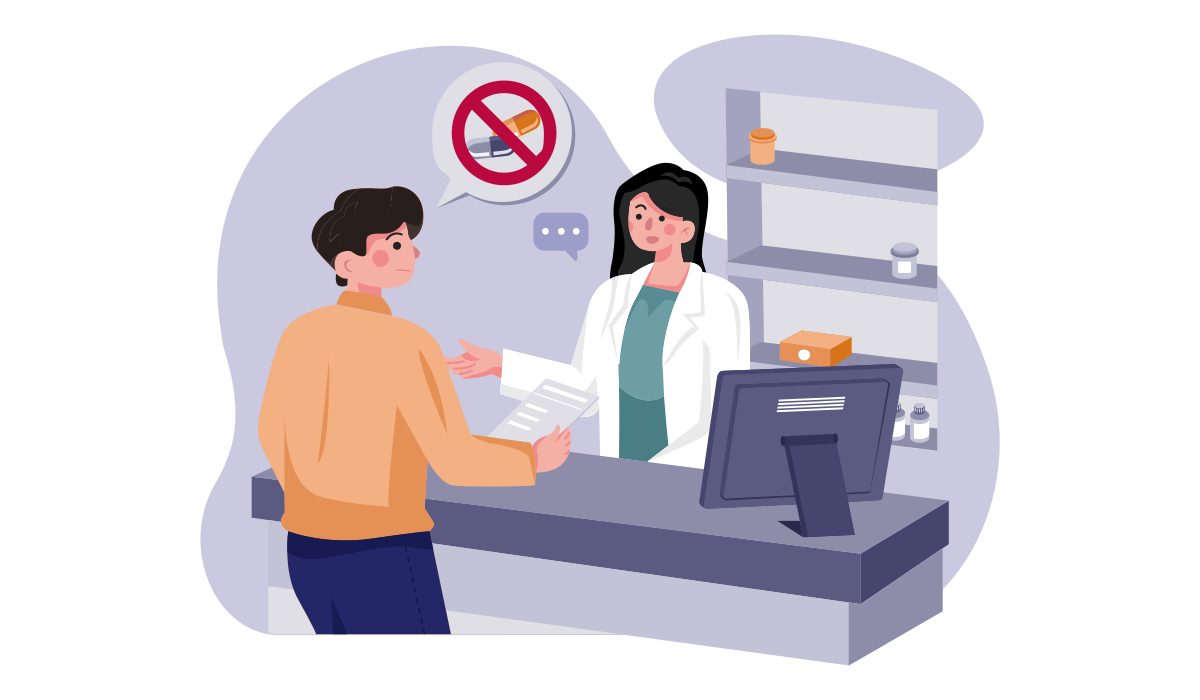
As pharmacists are often the most accessible health care providers, authorizing pharmacists to prescribe certain medicines could create simpler pathways to care for patients, especially in rural areas. This also applies to the treatment of OUD. Many people experiencing OUD might not have access to a doctor or may feel uncomfortable seeking medical treatment due to stigma. Authorizing pharmacists to initiate and manage buprenorphine treatment can break down barriers to accessing life-saving care.
Pharmacists are also poised to detect potential OUD early on. As pharmacists see patients each time they fill their prescription, they are often the first health care providers to know if a patient has signs of OUD, like consistently refilling their prescriptions early, obtaining prescriptions from multiple doctors, or being prescribed very high doses of opioids. As medication experts, pharmacists have educated their patients about opioid dependence, offered rescue drugs like naloxone, and discussed alternatives to opioids that are less dangerous. Now, after the passage of the SUPPORT Act, pharmacists will be able to intervene early and support patients with OUD on their recovery journey.